
Finned tubes are used in applications involving the transfer of heat from a hot fluid to a colder fluid through a tube wall. The rate at which such heat transfer can occur depends on three factors: (1) the temperature difference between the two fluids; (2) the heat transfer coefficient between each of the fluids and the tube wall; and (3) the surface area to which each fluid is exposed. In the case of a bare (unfinned) tubes, where the outside surface area is not significantly greater than the inside surface area, the fluid with the lowest heat transfer coefficient will dictate the overall heat transfer rate. When the heat transfer coefficient of the fluid inside the tube is several times larger than that of fluid outside the tube (for example steam inside and oil outside), the overall heat transfer rate can be greatly improved by increasing the outside surface of the tube. In mathematical terms, the product of heat transfer coefficient for the outside fluid multiplied by the outside surface area is made to more closely match the product of the inside fluid heat transfer coefficient multiplied by the inside surface area.
“The whole concept of finned tubes is to increase the outside surface area of the tube.”
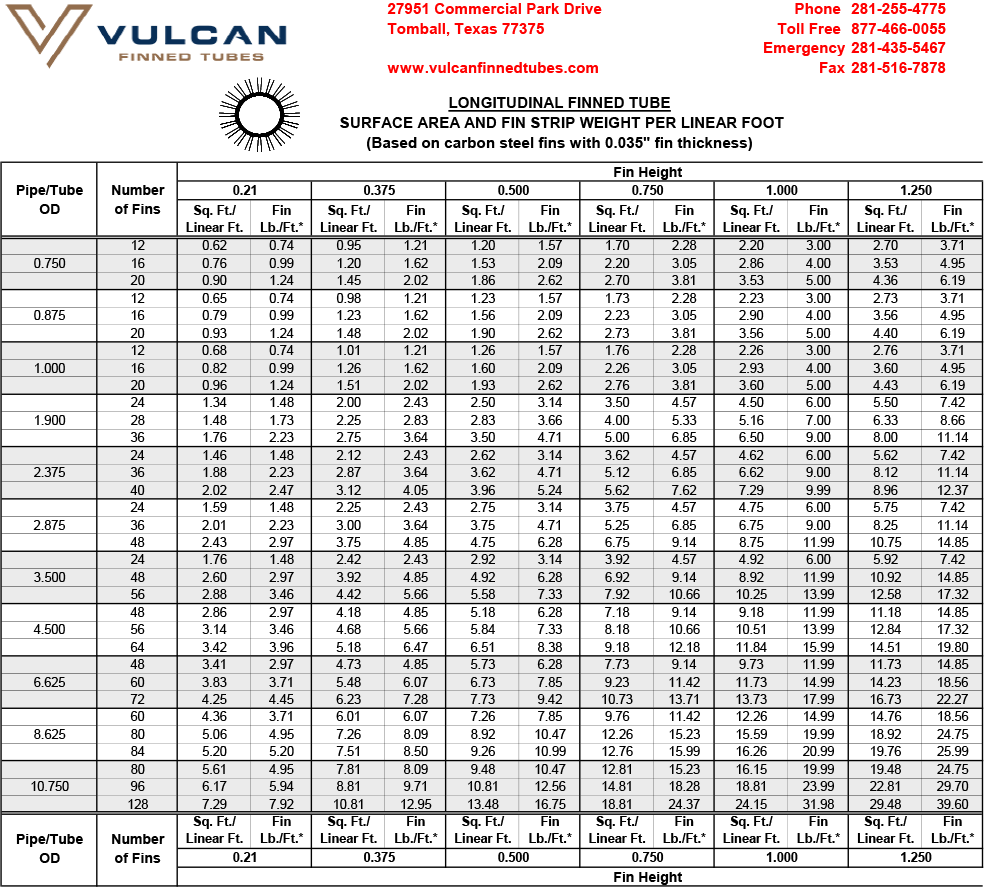
So the whole concept of finned tubes is to increase the outside surface area of the tube. As an example, a finned tube configuration of 2” (nominal, 2.375” actual) pipe with a ¾” high welded helical solid fin of 12 gauge thickness with 6 fins per inch has an outside surface area of 8.23 sq. ft. per linear foot; whereas the same bare pipe has an outside surface area of only .62 sq. ft. per linear foot. That is a 13X increase in outside surface area. See Design Information for extensive tables of surface areas and fin weights.
“In many cases, one finned tube replaces six or more bare tubes at less than 1/3 the cost and 1/4 the volume.”
By increasing the outside surface area of the tube, the overall heat transfer rate is increased, thereby reducing the total number of tubes required for a given application. This reduces the overall equipment size and the cost of the project. In many cases, one finned tube replaces six or more bare tubes at less than 1/3 the cost and ¼ the volume.